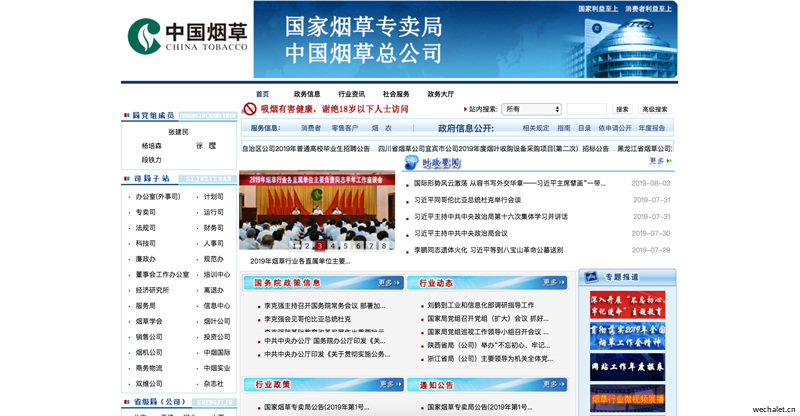
State Tobacco Monopoly Administration
Country: China Type: government
Tag: tobacco
Chinese Websites: http://www.tobacco.gov.cn/html/ Enter The Website
The Chinese tobacco industry implements a management system of unified leadership, vertical management, and monopoly. The State Tobacco Monopoly Administration and China National Tobacco Corporation carry out centralized and unified management of the national tobacco industry in terms of personnel, finance, materials, production, supply, sales, domestic, foreign, and trade.
In May 1981, the State Council decided to implement national monopoly on tobacco; Established China National Tobacco Corporation in 1982; In 1983, the State Council issued the "Regulations on Tobacco Monopoly"; In 1984, the State Tobacco Monopoly Administration was established, with one set of institutions and two brands under China National Tobacco Corporation.
In 1991, the National People's Congress promulgated the Tobacco Monopoly Law of the People's Republic of China, and in 1997, the State Council issued the Regulations for the Implementation of the Tobacco Monopoly Law, which established and improved the national tobacco monopoly system in legal form. In November 2005, with the approval of the State Council, the General Office of the State Council issued the "Opinions on Further Streamlining the Asset Management System of the Tobacco Industry and Deepening the Reform of Tobacco Enterprises" (Guobanfa [2005] No. 57), clarifying that the tobacco industry would continue to implement a management system of "unified leadership, vertical management, and monopoly and specialization". China National Tobacco Corporation would exercise its shareholder rights over the state-owned assets of its affiliated industrial and commercial enterprises in accordance with the law, operate and manage state-owned assets, and assume the responsibility of preserving and increasing their value.
The "Three Determinations" plan issued by the State Council in 2008 further clarified the work responsibilities of the State Tobacco Monopoly Administration. Through the above stages, China has gradually formed a tobacco monopoly system and management system with "unified leadership, vertical management, and monopoly" as the core. Monopoly and monopoly include three major statutory licensing systems, namely: the statutory licensing system for the production, import, and export of tobacco monopoly products. Tobacco monopoly products refer to cigarettes, cigars, cut tobacco, roasted tobacco leaves, tobacco leaves, cigarette paper, filter rods, cigarette bundles, and tobacco specific machinery; The legal license system for the sales and operation entities of tobacco monopoly products; The legal permit system for the transportation of tobacco monopoly products.
At present, the total number of employees in the tobacco industry in China is about 550000, with 33 provincial-level tobacco monopoly bureaus (companies), 451 prefecture level tobacco monopoly bureaus (companies), and 2417 county-level tobacco monopoly bureaus (branches or marketing departments); There are 19 provincial-level cigarette industry companies and 94 cigarette production points; 26 enterprises engaged in leaf drying and re baking; 512 diversified enterprises of various types; Invest and establish 30 cigarette factories and supporting enterprises overseas. There are also directly affiliated scientific research units and production enterprises such as tobacco machines and vinegar fibers. There are over 5.2 million cigarette retailers and over 1 million tobacco farmers nationwide, and the tobacco industry involves the employment and livelihood of over 20 million people.
Since the implementation of the monopoly system in China's tobacco industry, under the correct leadership of the Party Central Committee and the State Council, as well as the strong support of local party committees, governments, and relevant departments, the advantages of the industry management system have been fully utilized to continuously deepen reforms, strengthen monopoly law enforcement, promote scientific and technological progress, strengthen basic management, and promote the continuous improvement of economic benefits. In 2018, the tobacco industry adhered to the general tone of seeking progress while maintaining stability, adhered to the new development concept, and took supply side structural reform as the main line. It strengthened innovation driven, brand driven, and reform driven efforts, accelerated the cultivation of new driving forces, and the overall economic operation was stable and steadily improving. The total tax revenue for the year was 1155.62 billion yuan, and the total amount of national finance contributed was 10000.8 billion yuan.